
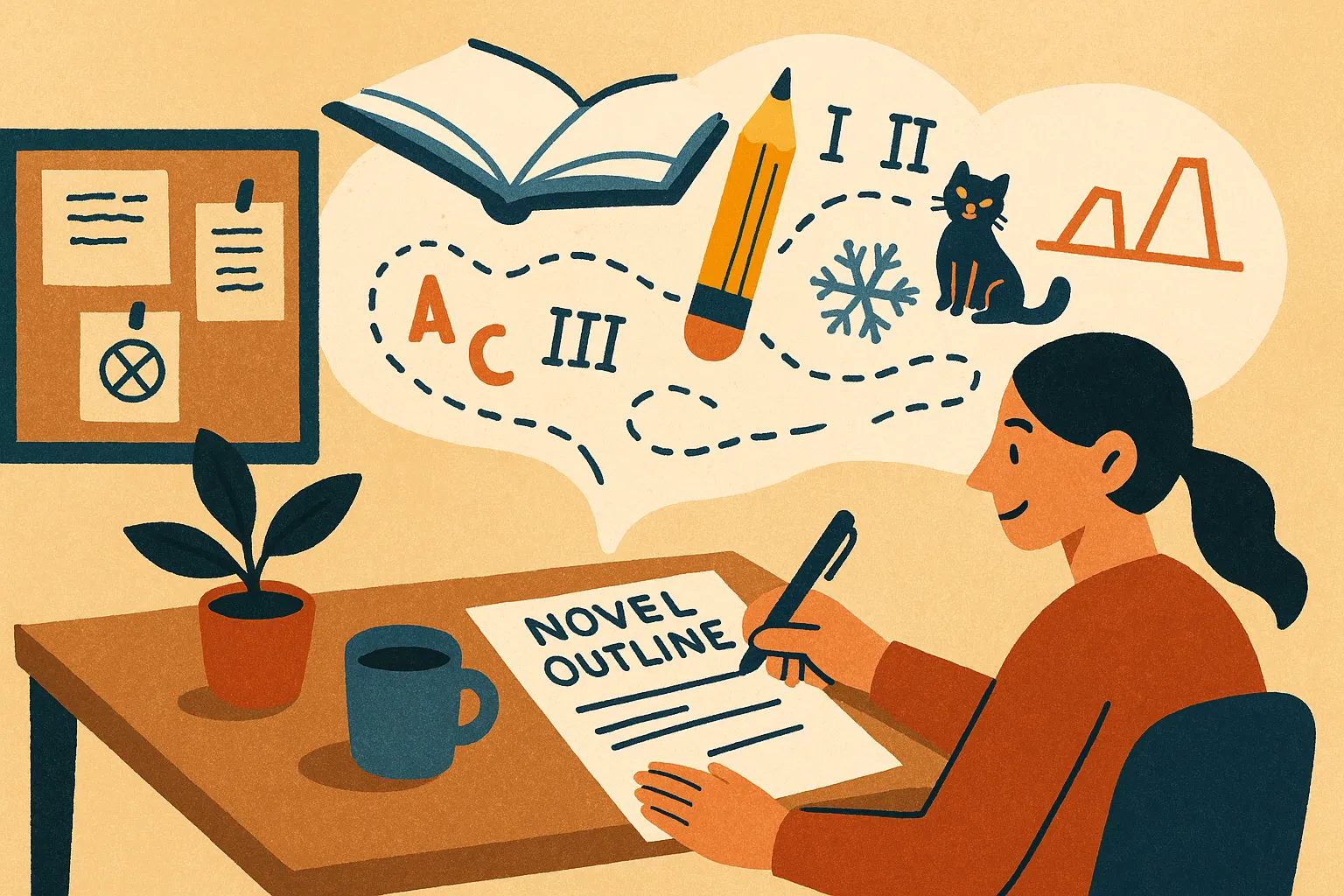
How to Outline a Novel: A Step-by-Step Guide for Fiction Writers
Whether you’re a meticulous planner or a fly-by-the-seat pantser, having some form of outline makes novel writing dramatically easier. An outline isn’t a cage — it’s a map. You can still take detours, but you’ll always know where the road leads.
Why Bother Outlining?
Most writers who abandon novels do so around the 20,000-word mark. That’s where the initial excitement fades and the “mushy middle” begins. An outline solves this by giving you a destination when motivation runs dry.
Key benefits:
- Catch plot holes early before you’ve written 50,000 words around them
- Maintain pacing by seeing the whole arc at a glance
- Write faster because you know what happens next
- Reduce revision time significantly
The Three-Act Structure
This is the foundation most outlines build on. It’s simple, time-tested, and works across genres.
Act One: Setup (roughly 25%)
Introduce your protagonist, their world, and the status quo. Then shatter it with the inciting incident — the event that forces your character into the story.
Act Two: Confrontation (roughly 50%)
Your protagonist pursues their goal against rising opposition. The midpoint raises the stakes. The “all is lost” moment at the end of Act Two forces a fundamental change.
Act Three: Resolution (roughly 25%)
The climax, the final confrontation, and the new status quo. Everything you set up pays off here.
The Snowflake Method
Created by Randy Ingermanson, this method starts small and expands:
- Write a one-sentence summary of your novel
- Expand it to a paragraph (setup, three disasters, ending)
- Write a one-page summary of each major character
- Expand each sentence of your paragraph into a full paragraph
- Write a one-page synopsis for each character
- Expand your four-paragraph summary into four pages
- Create character charts
- Make a scene list from your expanded synopsis
The beauty of this approach is that you can stop at any step and start writing.
Save the Cat! Beat Sheet
Blake Snyder’s beat sheet, adapted for novels by Jessica Brody, breaks your story into 15 beats:
- Opening Image — a snapshot of the “before”
- Theme Stated — someone hints at the lesson your hero needs to learn
- Setup — the hero’s flawed world
- Catalyst — the inciting incident
- Debate — the hero hesitates
- Break into Two — the hero commits
- B Story — the subplot (often a love interest or mentor)
- Fun and Games — the promise of the premise
- Midpoint — false victory or false defeat; stakes rise
- Bad Guys Close In — internal and external pressure mounts
- All Is Lost — the hero’s lowest point
- Dark Night of the Soul — the hero processes the loss
- Break into Three — the “aha” moment
- Finale — the hero applies what they’ve learned
- Final Image — a snapshot of the “after,” mirroring the opening
Which Method Should You Use?
There’s no single right answer. Consider:
- If you’re new to outlining, start with the three-act structure. It’s the simplest framework.
- If you like building gradually, try the Snowflake Method.
- If you want beat-by-beat guidance, Save the Cat is excellent.
- If you write series, a combination approach works best — broad strokes for the series arc, detailed beats for each book.
Tips for Outlining Success
- Keep it flexible. Your outline is a living document, not a contract.
- Include emotional beats, not just plot points. How does your character feel at each turning point?
- Note your key scenes first — the moments you’re most excited to write — then build the connective tissue around them.
- Don’t outline away your enthusiasm. If you feel the urge to start writing, start writing. You can outline the rest later.
The best outline is the one that gets you to “The End.” Experiment with different methods until you find what clicks for your creative process.
Ready to start writing?
Try Laterpress free — no credit card required.
Get started free